
“Pre” and “post” show up everywhere, from pre-launch checklists to post-event reports. They look simple, but writers still trip over them, mostly on hyphens and context. This guide covers what each prefix means, how to use them in sentences, which mistakes to avoid, and how to choose the right one every time.
Read More About This: Quizes or Quizzes? Which Spelling Is Correct?
What Do “Pre” and “Post” Mean?

Both are prefixes. A prefix is a small word part attached to the front of a word to change its meaning. Both come from Latin, and they sit at opposite ends of a timeline.
Pre Meaning
“Pre-” means “before” or “in front of.” It marks something that happens earlier than a specific event or point.
- Preview: a look before the full release
- Prepaid: paid before use
- Pre-season: the period before the main season
- Prenatal: before birth
Post Meaning
“Post-” comes from the Latin word for “after” or “behind.” It marks something that happens later than a specific event.
- Postgame: after the game
- Postpone: to move to a later time
- Postscript: a note added after the main text
- Postoperative: after surgery
Key Takeaway
Pre = before. Post = after. Both need a reference point, such as a surgery, a launch, or a war. Without one, the prefix has nothing to measure from.
Pre vs Post: Key Differences Explained
| Feature | Pre- | Post- |
| Meaning | Before | After |
| Origin | Latin prae | Latin post |
| Timeline position | Earlier | Later |
| Example | Pre-launch | Post-launch |
| Typical use | Preparation, planning | Review, results |
| Opposite | Post- | Pre- |
Why This Matters
Mixing them up flips your meaning. A “pre-event survey” and a “post-event survey” collect different information at different times. In business, health, research, and SEO content, that mistake can mislead readers or skew results.
Quick Example
- Pre-workout snack: eaten before exercise
- Post-workout snack: eaten after exercise
Same word, opposite timing.
How to Use Pre vs Post Correctly in Sentences
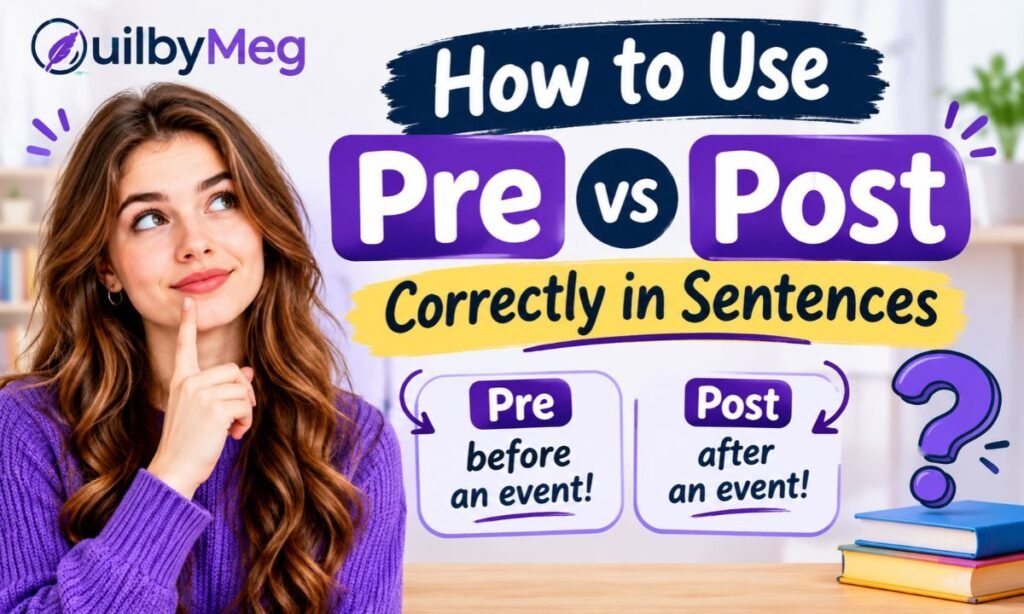
Three simple rules cover most situations.
Rule 1: Identify the Event
Start by finding the event your sentence revolves around. Then ask whether your point falls before or after it.
- The team held a pre-match briefing. (before the match)
- Fans gathered for the post-match interview. (after the match)
Rule 2: Use Hyphenation Properly
Hyphen rules vary by style guide, but the general pattern is steady. Most words with these prefixes are written closed, with no hyphen. In most cases, a hyphen isn’t needed to attach these prefixes to a word, as in prenatal.
Use a hyphen in these cases:
- Before a capital letter: pre-Renaissance, post-Victorian
- Before numbers: pre-1900, post-2020
- Before a compound: pre-nineteenth-century art
- When letters collide or clarity suffers: pre-eminent, post-traumatic
Style guides are also moving toward fewer hyphens. The National Association of Broadcasters, for example, dropped its general hyphen rule for these prefixes in a 2024 change aimed at consistency. Whatever you choose, stay consistent within one piece of writing.
Rule 3: Match Context Clearly
Make sure readers know what the prefix refers to.
- ❌ “The pre report was sent.” (before what?)
- ✅ “The pre-launch report was sent.”
When the reference point is obvious, the sentence reads cleanly. When it isn’t, add it.
Common Mistakes with Pre vs Post
Mistake 1: Using the Wrong Prefix
Writers often reach for the wrong one when the sequence feels backwards.
- ❌ “Complete the post-registration form to sign up.” (you fill it out before you’re registered)
- ✅ “Complete the pre-registration form to sign up.”
Mistake 2: Overusing Hyphens
Not every prefixed word needs a hyphen.
| Avoid | Prefer |
| pre-planning | preplanning (or simply “planning”) |
| post-production | postproduction |
| pre-test | pretest |
Some writers keep the hyphen when letters repeat, as in post-test. Pick one rule and apply it everywhere.
Mistake 3: Confusing Context
Read More About This: Triple vs. Tripple: Which Spelling Is Correct?
“Post” doubles as a standalone word: a blog post, a fence post, to post online. Compare:
- “We’ll post the update tomorrow.” (a verb)
- “We’ll review it post-update.” (a prefix meaning after)
Read the sentence aloud. If “after” fits, you’re using the prefix.
Pro Tip
If you’re unsure, swap in the plain words. Replace pre- with “before” and post- with “after.” If the sentence still makes sense, you’ve chosen correctly.
Real-Life Case Study: Marketing Campaign Mistake

This is an illustrative scenario based on a common content-team error, not a documented company case.
What Happened?
A small e-commerce team ran a product launch. Their email subject line read: “Post-order bonuses available now!” They meant bonuses customers could claim before ordering. Many readers assumed the offer only applied after buying, so they ignored it.
Fix Applied
The team rewrote the subject line as “Pre-order bonuses available now!” They also added one short sentence in the email body explaining that the offer ended when orders opened.
Outcome
The corrected message matched what readers expected. Questions to support dropped, and the offer was easier to understand at a glance.
Lesson Learned
A single prefix can change the meaning of an entire campaign. Have someone check the timing word in any headline, subject line, or CTA before it goes live.
Data & Usage Trends (2025–2026)
I haven’t cited exact search-volume figures here, since they shift constantly and vary by tool. The patterns below come from how style guides and content teams are handling these prefixes.
| Trend | What’s Happening |
| Fewer hyphens | Style guides are moving toward closed forms (postgame, prelaunch) |
| Context-driven phrases | “Post-pandemic,” “pre-launch,” and “pre-order” dominate everyday writing |
| Business and research use | “Pre- and post-” comparisons are common in surveys, training, and health studies |
| Clarity over rules | Writers hyphenate when it prevents confusion, even if a rule says otherwise |
What This Means
Readers care less about strict hyphen rules and more about being understood quickly. Choose the form that is easiest to read, then keep it consistent. For SEO content, match the spelling people actually search for, and use the alternative once naturally in the text.
Step-by-Step Guide: Choosing Between Pre and Post
Step 1: Identify the event
Find the milestone your sentence centers on, such as a launch, surgery, exam, or sale.
Step 2: Determine timing
Ask whether the action happens before or after that event.
Step 3: Apply the prefix
- Before the event → pre-
- After the event → post-
Step 4: Check clarity
Read the sentence aloud. Would a stranger understand what the prefix refers to? If not, name the event.
Step 5: Review formatting
Decide on the hyphen using the rules above (capital letters, numbers, compounds, awkward letter clashes). Then make sure every similar word in your piece is treated the same way.
FAQs
What is the main difference between pre and post?
“Pre” means before an event, and “post” means after it.
Can pre and post be used without a hyphen?
Yes. Most common words, like prepaid and postgame, are written closed with no hyphen.
Is it correct to say pre and post analysis?
Yes. A tidy form is “pre- and post-analysis,” or “pre- and postanalysis” if you prefer closed spelling.
Are pre and post only used for time?
Mostly, but “pre” can also mean “in front of” (prefrontal) and “post” can mean “behind” (posterior).
Which is correct: preplanning or pre-planning?
Both appear in print, but preplanning is the more current closed form. Plain “planning” is often enough.
Why is pre vs post important in SEO content?
Searchers use both forms, and clear timing words improve readability, which helps match intent.
Conclusion
“Pre” means before and “post” means after, and that’s the core of it. Pick the event, decide on the timing, choose the prefix, and check whether a hyphen helps or just clutters. When in doubt, swap in “before” or “after” to test your sentence.
Get the small things right, and your writing reads clearer, ranks better, and avoids the kind of mix-up that sent one campaign off course.




2 thoughts on “Pre vs Post: Meaning, Differences, Correct Usage & Examples”