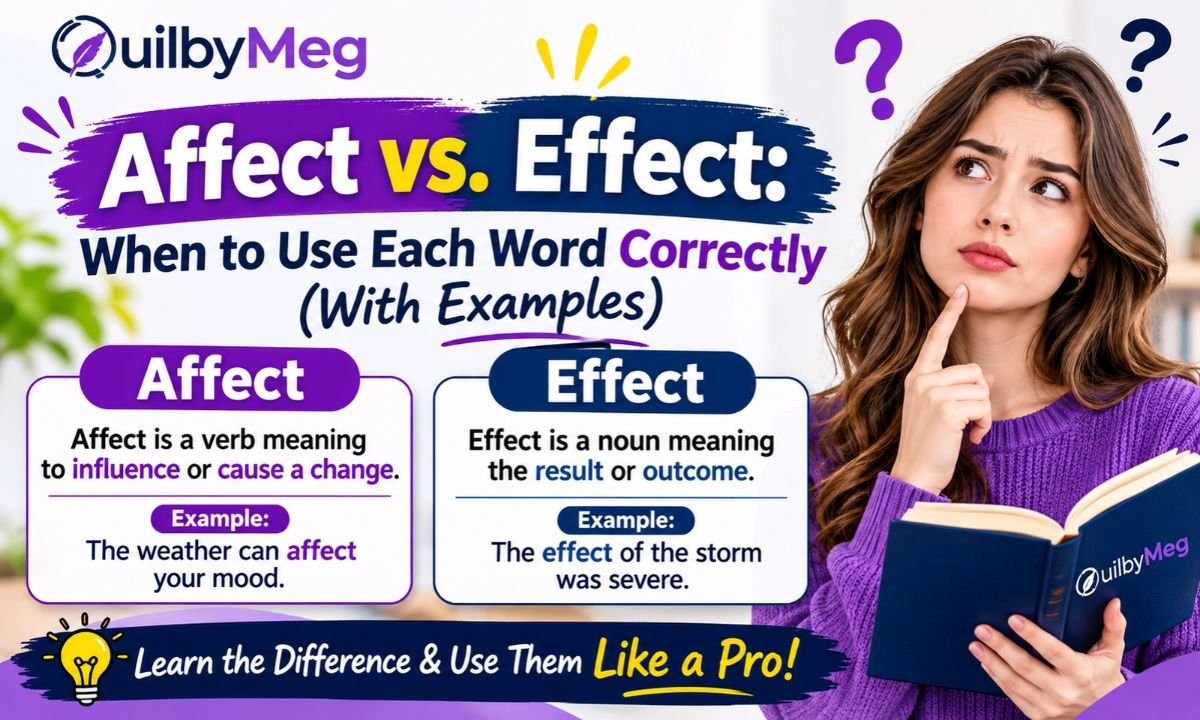
Few word pairs trip up writers as often as affect and effect. They sound almost identical, their meanings overlap, and both can switch roles in rare cases. The good news is that one simple rule covers most situations: affect is usually a verb, and effect is usually a noun.
This guide explains the difference, shows both words in real sentences, and gives you memory tricks you can use right away.
Read More About This: Tieing or Tying? Which Spelling Is Correct?
Quick Answer: Affect vs Effect
- Affect (verb) means to influence or change something. Lack of sleep affects your focus.
- Effect (noun) means a result or outcome. Lack of sleep has a bad effect on your focus.
Prevent Your Manuscript From Desk & Blind Review Rejections

Small word-choice errors can cost you more than you think. Journal editors often screen submissions quickly, and a manuscript with repeated grammar mistakes can look careless before anyone reads the research. Reviewers in blind peer review also judge your writing by what is on the page, since they cannot see your name or reputation.
Affect and effect appear constantly in academic writing, especially in psychology, medicine, economics, and social science papers. A sentence like “The treatment effected patient mood” instead of “affected” changes the meaning and signals weak editing.
Before you submit, check these points:
- Search your draft for every use of “affect” and “effect.”
- Ask whether each one is an action (verb) or a result (noun).
- Watch for phrases such as “side effects,” “cause and effect,” and “had an effect on.”
- Have a second reader or a proofreading tool confirm your choices.
Clean usage will not guarantee acceptance, but it removes an easy reason for rejection.
What is the Meaning of Affect?

Most of the time, affect is a verb that means to influence, impact, or produce a change in someone or something.
Affect as a Verb
Use affect when one thing acts on another.
- The weather affects my mood.
- Rising interest rates affected home sales last year.
- Caffeine can affect how well you sleep.
- Budget cuts will affect every department.
If you can replace the word with “influence” or “change,” you want affect.
Affect as a Noun (Rare)
In psychology, affect (pronounced with stress on the first syllable) is a noun. It describes a person’s visible emotional expression.
- The patient showed a flat affect during the interview.
- Her cheerful affect hid how nervous she was.
You will mostly see this use in clinical notes, research papers, and mental health writing.
Affect as a Verb Meaning “to Pretend”
Less commonly, affect means to put on a false show or behavior.
- He affected a British accent at the party.
- She affected an air of confidence before her presentation.
This meaning is formal and often appears in literature. It is also the root of the word affectation.
What is the Meaning of Effect?
Read More About This: Really vs. Realy: Which Is Correct?
Most of the time, effect is a noun that means a result, outcome, or consequence.
Effect as a Noun
Use effect when you are naming the result of something.
- The new policy had a positive effect on sales.
- Sunlight has a calming effect on many people.
- The medicine’s side effects were mild.
- The special effects in the film were impressive.
Notice the common pattern. Effect often follows words like the, an, no, any, side, or special.
Effect as a Verb (Formal)
As a verb, effect means to bring about or cause something to happen. It is more formal and less common than the noun.
- The new manager hopes to effect real change in the company.
- Protesters worked to effect a change in the law.
Here you are not simply influencing a change. You are creating it. That difference is why “affect change” and “effect change” mean two different things.
Common Phrases With Effect
| Phrase | Meaning |
| Cause and effect | A reason and its result |
| Take effect | Begin to work or become active |
| Come into effect | Become official or valid |
| In effect | Essentially; in practice |
| Side effect | An unintended result |
| Domino effect | A chain of results |
| To that effect | With that general meaning |
Remembering the Meaning of Affect and Effect

Memory tricks help most when you are writing quickly. Try one of these.
The RAVEN Trick
Remember: Affect is a Verb, Effect is a Noun.
This one handles the majority of everyday sentences.
The A and E Trick
- Affect = Action
- Effect = End result
An action comes first, and the end result follows.
The Substitution Test
Swap the word with a simple synonym.
- If “influence” fits, use affect.
- If “result” fits, use effect.
Example: “The noise didn’t (affect/effect) her.” Replace it with “influence.” That works, so the answer is affect.
The Article Test
If a word like a, an, or the comes right before it, you almost always need effect. If the word comes after will, would, can, or to, you usually need affect.
Affect vs Effect Comparison Table
| Feature | Affect | Effect |
| Usual part of speech | Verb | Noun |
| Core meaning | To influence | A result |
| Rare part of speech | Noun (emotional expression) | Verb (to bring about) |
| Quick memory aid | Action | End result |
| Example | Stress can affect sleep. | Stress has an effect on sleep. |
Common Mistakes to Avoid
- Side affects is wrong. The correct phrase is side effects.
- Take affect is wrong. Use take effect.
- The affect of the storm is wrong in most cases. Use the effect of the storm.
- Effected by the change is usually wrong. Use affected by the change.
Frequently Asked Questions
Is it affect or effect in “how does it affect you”?
It is affect. In this sentence, it is a verb meaning “influence.”
Is it side affects or side effects?
The correct phrase is side effects. Here, effect is a noun meaning a result.
Can affect be a noun?
Yes. In psychology, affect is a noun meaning a person’s visible emotional expression.
Can effect be a verb?
Yes. As a verb, effect means to bring about, as in “effect change.”
What is the difference between affect change and effect change?
To affect change means to influence an existing change. To effect change means to create it.
Is it take effect or take affect?
It is take effect. The phrase means to begin working or become active.
What is an easy way to remember affect vs effect?
Use RAVEN: Remember, Affect is a Verb, Effect is a Noun.
Final Considerations on Using Affect and Effect
Here is the short version you can carry with you:
- Use affect when you mean to influence something.
- Use effect when you mean a result.
- Remember the exceptions: affect as an emotional expression, and effect as “to bring about.”
- Run the substitution test when you are unsure.
- Reread your draft once more before publishing or submitting.
Practice makes this automatic. Write a few of your own sentences using each word, then check them against the rules above. If you still hesitate on a tricky sentence, rewrite it with a clearer verb such as influence, change, or cause. Clear writing always beats a risky word choice.






2 thoughts on “Affect vs. Effect: When to Use Each Word Correctly (With Examples)”