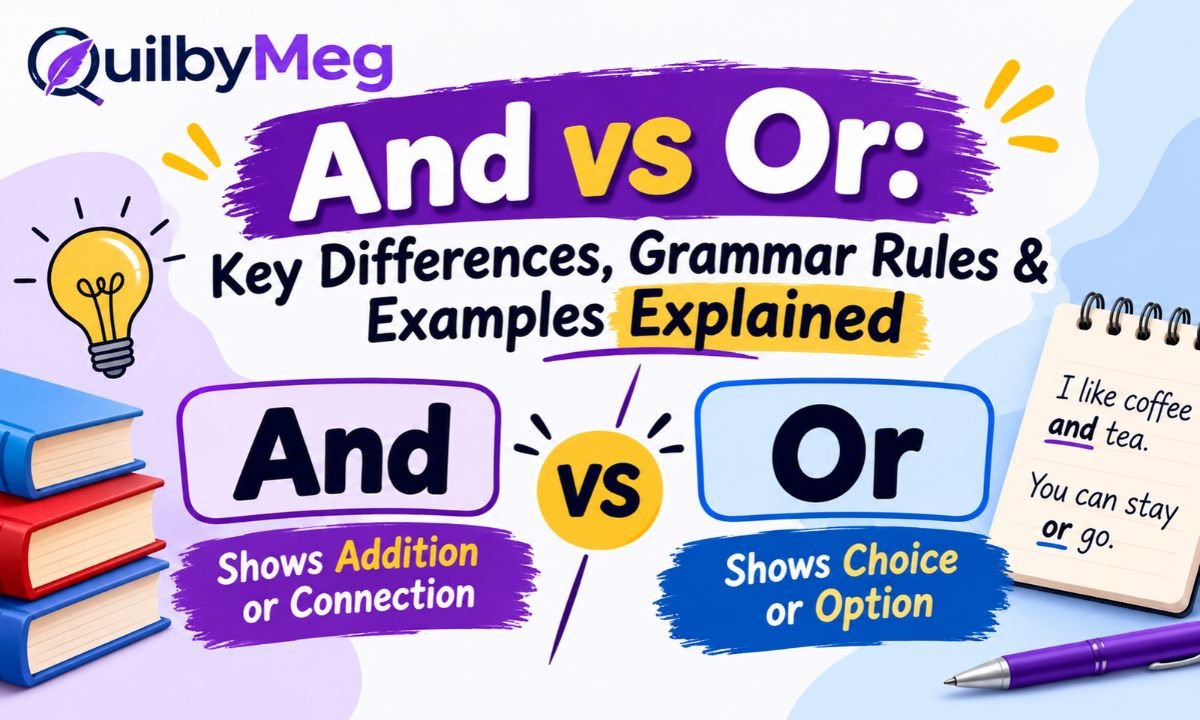
Few words are as small, or as easy to mix up, as “and” and “or.” Both are conjunctions that connect words, phrases, and clauses. But they send opposite signals: one adds things together, the other offers a choice. This guide explains the difference between and vs or, the rules behind them, and the mistakes to avoid.
Read More About This: Batton or Baton: Which Is the Correct Spelling?
Quick answer
- And joins items together. Everything listed applies. “I need a pen and a notebook.” (Both.)
- Or gives alternatives. At least one item applies. “You can pay by card or cash.” (One option.)
Quick memory trick: “And” adds more. “Or” offers options.
What Does “And” Mean?

“And” is a coordinating conjunction that connects words, phrases, or clauses of equal weight. It signals addition, combination, or sequence. In logic, it is called a conjunction: a statement joined by “and” is true only when every part is true.
- She sings and plays the guitar. (She does both.)
- We washed the car, and then we went home. (Sequence.)
- The soup is hot and spicy. (Two qualities together.)
What Does “Or” Mean?
“Or” is a coordinating conjunction that presents a choice, alternative, or possibility. In logic, it is called a disjunction: a statement joined by “or” is true when at least one part is true.
- Would you like tea or coffee?
- You can take the bus or walk.
- He is either tired or bored.
And vs Or: Key Differences (Easy Table)
| Feature | And | Or |
| Main job | Adds or combines | Offers a choice |
| Meaning | All items apply | At least one item applies |
| Logic term | Conjunction | Disjunction |
| Effect on options | Narrows (all conditions needed) | Widens (any condition is enough) |
| Verb with subjects | Usually plural | Agrees with the nearest subject |
| Example | I like apples and pears. | I like apples or pears. |
When to Use “And” (With Real Examples)

Use “and” when you want to:
- Add items: We bought milk, eggs, and bread.
- Combine actions: He opened the door and walked in.
- Connect related ideas: The film was funny and moving.
- Show requirements that must all be met: You must be 18 and hold a valid ID.
- Link numbers or pairs: Two and two make four.
When to Use “Or” (With Real Examples)
Read More About This: Losing vs Loosing: What’s the Correct Spelling
Use “or” when you want to:
- Offer alternatives: Do you want to stay or leave?
- Give possibilities: It might rain or snow tonight.
- Show that any one condition is enough: Bring a passport or a driver’s license.
- Restate or clarify: He studies ornithology, or the study of birds.
- Warn about consequences: Hurry up, or we’ll miss the train.
And vs Or in Real-Life Situations
The same two words change the meaning of everyday instructions.
| Situation | With “And” | With “Or” |
| Job posting | Applicants need a degree and five years of experience. (Both required.) | Applicants need a degree or five years of experience. (Either works.) |
| Restaurant menu | Meal comes with soup and salad. (You get both.) | Meal comes with soup or salad. (You pick one.) |
| Online filter | Show shoes that are red and size 9. (Narrow results.) | Show shoes that are red or size 9. (Wider results.) |
| Entry rules | Show a ticket and ID. | Show a ticket or ID. |
If you set up search filters, spreadsheet formulas, or automation rules, this distinction matters. “And” shrinks the results, and “or” expands them.
Common Mistakes with “And” and “Or”
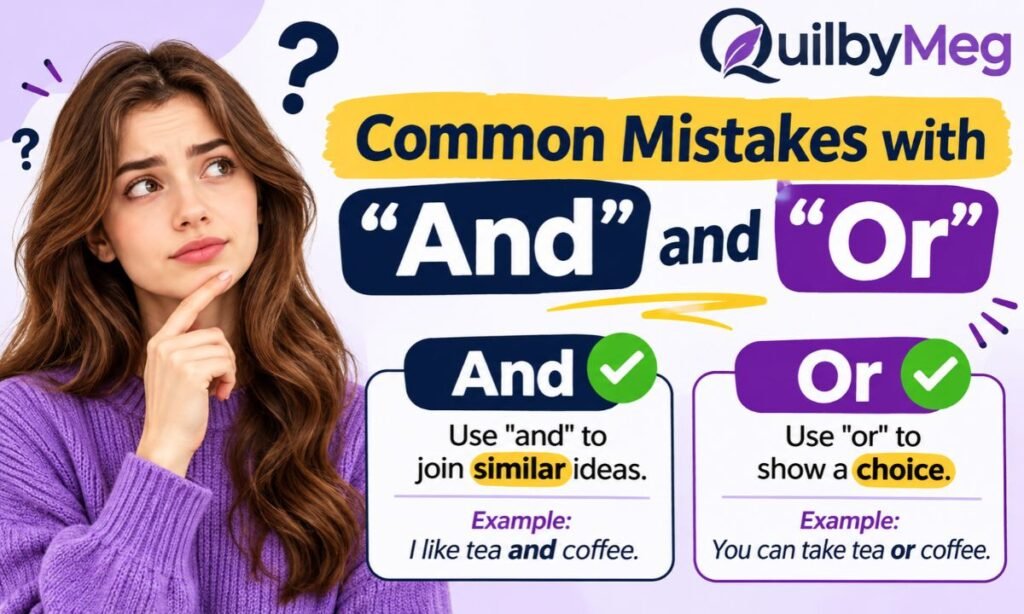
- Mistake 1: Using “and” when you mean a choice.
❌ You can choose chicken and fish. ✅ You can choose chicken or fish. - Mistake 2: Using “or” when all items are required.
❌ Students must submit a form or a photo. (if both are needed) ✅ Students must submit a form and a photo. - Mistake 3: Using “and” in negative sentences.
❌ I don’t like tea and coffee. ✅ I don’t like tea or coffee. - Mistake 4: Wrong verb agreement. ❌ Neither the teacher or the students was ready. ✅ Neither the teacher nor the students were ready.
- Mistake 5: Overusing “and/or.” It often makes writing vague. More on that below.
Can You Use “And” and “Or” in the Same Sentence?
Yes, but be careful. A sentence that mixes both can be ambiguous.
“We need a laptop and a phone or a tablet.”
Does this mean (laptop and phone) or tablet, or laptop and (phone or tablet)? To avoid confusion:
- Rewrite it: “We need a laptop, plus either a phone or a tablet.”
- Split it into two sentences.
- Use parentheses in technical or legal writing.
Advanced Tip: Inclusive vs Exclusive “Or”
- Inclusive or means one or both. “You can add milk or sugar.” (You may add both.)
- Exclusive or means one but not both. “You can have cake or ice cream.” (Pick one.)
English usually relies on context to tell these apart. When it matters, add clarity:
- Inclusive: “milk, sugar, or both.”
- Exclusive: “either cake or ice cream, but not both.”
In logic and programming, this is the difference between OR and XOR.
And vs Or in Writing vs Speaking

When speaking, tone and context usually settle the meaning. If someone says “Tea or coffee?” with rising intonation, you know it is a choice. In writing, you have no tone, so the word choice must carry all the meaning. That is why contracts, instructions, and product pages need extra care.
Written English also tends to prefer parallel structure: “She likes hiking, swimming, or cycling” sounds cleaner than mixing forms.
Quick Practice Sentences (Test Yourself)
Fill in the blank with and or or:
- You need a username ___ a password to log in.
- Would you like rice ___ noodles?
- I don’t eat meat ___ fish.
- She is smart ___ kind.
- Call me today ___ tomorrow.
Answers: 1. and 2. or 3. or 4. and 5. or
And vs Or Logic
In logic, these words work like operators, and truth tables explain them:
| A | B | A and B | A or B |
| True | True | True | True |
| True | False | False | True |
| False | True | False | True |
| False | False | False | False |
- AND is true only if both statements are true.
- OR is true if at least one statement is true.
This is the same idea used in search engines, databases, and spreadsheets.
And vs Or Examples
| Type | And | Or |
| Everyday | I’ll have pizza and fries. | I’ll have pizza or pasta. |
| Rules | Pass the test and attend class. | Pass the test or retake the course. |
| Math | x > 2 and x < 5 (between 2 and 5) | x < 2 or x > 5 (outside that range) |
| Tech | Tag = “sale” AND price < 50 | Tag = “sale” OR price < 50 |
And vs Or Symbol
Neither word has one universal symbol, but these are common:
- And: the ampersand (&), plus sign (+), or ∧ in formal logic; && in many programming languages.
- Or: ∨ in formal logic; || in many programming languages; a slash (/) is sometimes used informally (“he/she”).
Use the ampersand in names and logos (Johnson & Sons), not in formal sentences.
And vs Or in a List
- Use “and” before the last item when all items apply: “We visited Paris, Rome, and Madrid.”
- Use “or” before the last item when the items are alternatives: “Choose red, blue, or green.”
The comma before “and” or “or” in a list is called the Oxford (serial) comma. It is optional in many styles but helps avoid confusion. Compare: “I love my parents, Lady Gaga and Humpty Dumpty” versus “…Lady Gaga, and Humpty Dumpty.”
And vs Or Rules
- “And” combines; “or” separates.
- Use “or” in negative sentences instead of “and” (“no sugar or salt”).
- Keep items in a series grammatically parallel.
- Match verbs correctly (see the subject-verb agreement section).
- Use “either… or” and “neither… nor” in matched pairs.
- Avoid stacking “and” and “or” without grouping.
Legal Difference Between And and And/Or
In contracts and legal documents, the choice has real consequences.
- “And” is conjunctive: all listed items are required.
- “Or” is disjunctive: any one listed item is enough.
- “And/or” tries to mean either or both, but many legal writers and some courts criticize it as ambiguous.
Clearer alternative: “The tenant must pay rent, utilities, or both.”
For example, “The seller shall provide a warranty and/or a refund” leaves doubt. Rewriting as “a warranty, a refund, or both” removes it. (This is general information, not legal advice; for real contracts, consult a lawyer.)
Difference Between And Punctuation
- Joining two independent clauses: use a comma before “and” or “or.” “I wanted to leave, but she wanted to stay, and neither of us moved.”
- Compound predicate (same subject): usually no comma. “She opened the door and walked out.”
- Lists of three or more: use commas between items, with an optional Oxford comma.
- Two items only: no comma. “Tea or coffee.”
- Starting a sentence: beginning with “And” or “Or” is acceptable in informal and creative writing, but use it sparingly in formal work.
10 Sentences With Or
- Do you want to walk or take a taxi?
- You can call me or send a message.
- Is it a cat or a small dog?
- Study hard, or you may fail the exam.
- We can meet on Monday or Tuesday.
- He didn’t say yes or no.
- Pick a pen or a pencil.
- Will you stay here or come with us?
- It costs ten or twelve dollars.
- Either you apologize, or I leave.
Additional Words for Clarity
When “and” or “or” alone feels unclear, these related words help:
| Purpose | Words and phrases |
| Add information | as well as, plus, along with, in addition to, both… and |
| Show choice | either… or, alternatively, otherwise, whether… or |
| Show a negative choice | neither… nor, not… or |
| Clarify “one or both” | “A, B, or both” |
| Clarify “one only” | “either A or B, but not both” |
And = Joining Independent Clauses
“And” often connects two full clauses, each with its own subject and verb.
“The sun set, and the stars appeared.”
Rules to keep in mind:
- Put a comma before “and” when joining two independent clauses.
- Do not put a comma when the second part lacks its own subject.
- Avoid endless chains of “and” (run-on sentences). Break long sentences into two or use a semicolon.
Subject-Verb Agreement With And/Or
- Subjects joined by “and” usually take a plural verb. “Maya and Sam are ready.”
- Subjects joined by “or” or “nor” make the verb agree with the nearest subject.
- “Either the manager or the employees are late.”
- “Either the employees or the manager is late.”
- Tip: place the plural subject last so the sentence sounds natural.
Exceptions
Exception #1
When two nouns joined by “and” make one single unit or idea, use a singular verb: “Macaroni and cheese is my favorite meal.” “Bread and butter is all I need.”
Exception #2
When “and” joins subjects preceded by each or every, the verb is singular: “Every boy and girl has a book.” “Each student and teacher was welcomed.”
FAQ’s
What is the basic difference between and vs or?
“And” combines items so that all apply, while “or” offers alternatives so that at least one applies.
Can and and or be used in the same sentence?
Yes, but group the ideas clearly, using commas, “either,” “both,” or separate sentences, so the meaning is not ambiguous.
What does and/or mean in a contract?
It suggests “either one or both,” but it is often considered ambiguous, so many writers prefer “A, B, or both.”
Is or always exclusive?
No. “Or” can be inclusive (one or both) or exclusive (one only), and context or added words decide which.
Does and always take a plural verb?
Usually, yes, but singular verbs are used when “and” joins a single unit (“Fish and chips is…”) or follows each/every.
How do I choose between and and or in a list?
Use “and” if every item applies and “or” if the reader must or may choose among the items.
Why do people confuse and vs or so often?
They look and sound simple, and in speech context fills the gaps, but in writing a single wrong word can reverse the meaning.
Final thoughts
The and vs or difference comes down to one idea: “and” adds, “or” offers a choice. Use “and” when everything must apply, use “or” when any one option is enough, and add words like both, either, or but not both whenever meaning could slip. Mind your punctuation and subject-verb agreement, and avoid vague “and/or” in important writing. Practice with the sentences above, and these two small words will stop tripping you up.








2 thoughts on “And vs Or: Key Differences, Grammar Rules & Examples Explained”