
You are typing a quick email, a invoice note, or a blog post. You write “the total ammount” and something looks off. Is it amount or ammount? This guide gives you the answer, the reason behind it, and simple ways to never get it wrong again.
Read More About This: Students vs. Student’s vs. Students’: Which Is Correct?
Amount or Ammount – Quick Answer
“Amount” is the only correct spelling. “Ammount” is a common misspelling and is not accepted in any dictionary, in American English or British English.
- Correct: The total amount is due on Friday.
- Incorrect: The total
ammountis due on Friday.
A spell checker will usually flag “ammount” right away. Still, the error slips into emails, forms, and code more often than you would think.
Ammount or Amount meaning
“Amount” can be a noun or a verb.
- Noun: the total quantity of something, especially something you cannot count one by one. Example: a small amount of sugar.
- Noun (money): a sum of money. Example: Please confirm the amount before payment.
- Verb: to add up to, or to be equal to. Example: His excuses amount to nothing.
“Ammount” has no meaning of its own. It is simply “amount” with one extra letter.
The Origin of Amount or Ammount

The word “amount” comes from Old French amonter, which meant “to go up” or “to climb.” That verb came from the phrase a mont, meaning “upward” or, literally, “to the mountain.” English borrowed it in the Middle Ages, first as a verb meaning “to add up to,” and later as the noun we use today.
So where does the extra “m” come from? Mostly from how we speak and type:
- Pronunciation. We say /əˈmaʊnt/ with a smooth “m” sound, and many people assume a double letter.
- Look-alike words. Words such as accommodate, commit, and summary train the eye to expect double “m” patterns.
- Fast typing. Pressing the “m” key twice is an easy slip on any keyboard.
The root is mont (mountain), which has just one “m” in the middle. Keep that in mind and the single “m” makes sense.
British English vs American English Spelling
Good news: there is no difference. Unlike color/colour or center/centre, “amount” is spelled the same in the US, UK, Canada, Australia, and India. “Ammount” is wrong everywhere.
Comparison Table
| Variety of English | Correct spelling | Accepted “ammount”? |
| American English | amount | No |
| British English | amount | No |
| Canadian English | amount | No |
| Australian English | amount | No |
| Indian English | amount | No |
Which Spelling Should You Use?
Always use amount. This applies to every kind of writing:
- Emails, reports, and academic papers
- Invoices, bank forms, and contracts
- Blog posts, captions, and social media
- Job applications and resumes
Here is a trick that works. Look inside the word: a-MOUNT. A mount is a mountain or a hill, and a mountain has one “m” in the middle. Think of the “amount” as a pile you stack up, like a small mount.
Common Mistakes with Amount or Ammount

The double “m” is only one of several errors people make with this word. Here are the ones you will see most.
Spelling it “ammount”
This is the main mistake. Check the middle of the word. It is a-m-o-u-n-t, six letters, one “m” in the middle.
Mixing up amount and number
Use amount for things you cannot count and number for things you can.
- Correct: a large amount of water, a large number of bottles
- Incorrect: a large amount of bottles
Confusing amount with account
They look alike, but the meanings are different. An account is a record or a bank profile. An amount is a quantity or a sum.
- Correct: Please check your account for the amount due.
Using “amounts” incorrectly
“Amounts” is correct when you mean several separate quantities: different amounts of flour. It is not a general plural for “amount of” with a single uncountable thing.
Typos in code and spreadsheets
This is a gap many guides skip. Developers often write names like ammount in variables, database columns, or form fields. The computer treats that as a different word from amount, which can cause real bugs. Always run a spelling check on variable names and labels, and keep one consistent spelling across the whole project.
Amount or Ammount in Everyday Examples
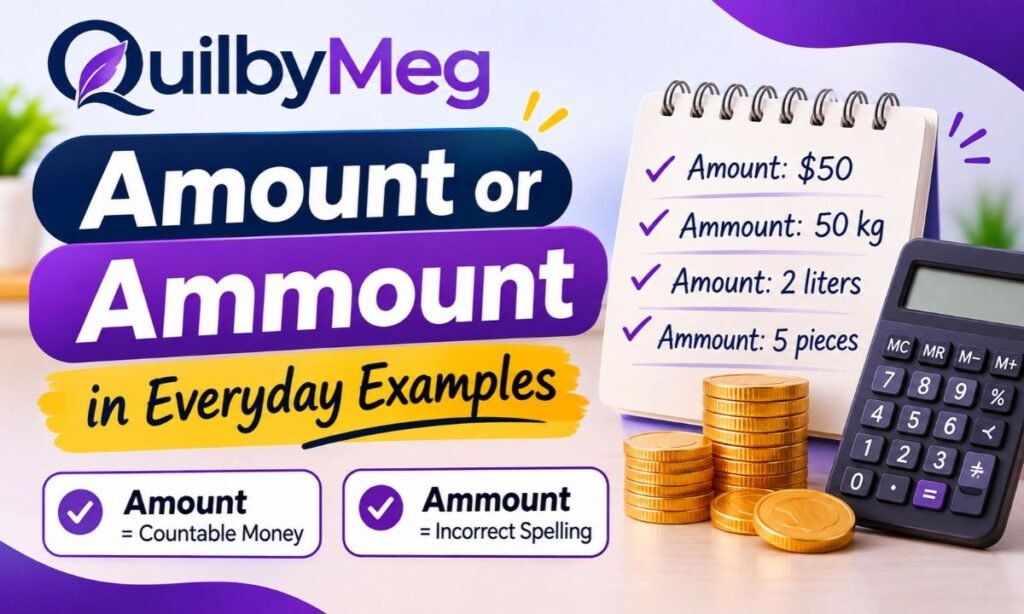
Seeing the word in context helps it stick. Each pair below shows the right form.
At work
- Correct: Please send the invoice with the full amount.
- Incorrect: Please send the invoice with the full ammount.
In daily life
- Correct: I drink a good amount of water every day.
- Correct: She saved a surprising amount of money this year.
In school and study
- Correct: The teacher gave a huge amount of homework.
- Correct: The amount of time you study matters.
With the verb form
- Correct: Small habits amount to big results over time.
On social media
- Correct: The amount of love in this photo is unreal.
Amount or Ammount – Google Trends & Usage Data
Search behavior tells a clear story. “Amount” is one of the most common words in English, used in banking, shopping, cooking, and science. “Ammount” shows up mainly as a search for people who want to check the spelling.
A few patterns to notice:
- People who type “ammount” are almost always looking for the correct form, not a second valid spelling.
- Interest rises around tax season, invoicing periods, and school terms, when people fill in forms and write reports.
- Searches mix both spellings with phrases like “amount or ammount” and “is ammount a word.”
For live numbers, search both terms in Google Trends and compare them over the past 12 months. The “amount” line sits far above the “ammount” line, which confirms which one writers actually use.
Amount or Ammount Comparison Table
| Feature | Amount | Ammount |
| Correct spelling | Yes | No |
| Found in dictionaries | Yes | No |
| Letters | 6 | 7 |
| Part of speech | Noun and verb | None |
| Root word | Old French amonter | None |
| Safe for formal writing | Yes | No |
| Example | The amount is correct. | The ammount is wrong. |
FAQs About Amount or Ammount
Is it amount or ammount?
The correct spelling is “amount.” “Ammount” is always a misspelling.
Is ammount a word?
No. “Ammount” is not in any standard dictionary and is a typo of “amount.”
How many m’s are in amount?
Only one. The word is spelled a-m-o-u-n-t.
Is amount spelled differently in British English?
No. British and American English both use “amount.”
What is an easy way to remember the spelling?
Think of the word “mount,” as in a mountain, and remember “a-mount” has just one “m” in the middle.
When should I use amount instead of number?
Use “amount” for uncountable things like water or time, and “number” for countable things like books or people.
What does amount mean?
It means a total quantity or sum of something. As a verb, it means to add up to.
Conclusion
The answer is simple: amount is correct, and ammount is a typo. There is only one “m” in the middle, and the spelling is the same in every English-speaking country.
Remember the mountain link, watch for the countable and uncountable rule, and check variable names if you write code. With those three habits, you will spell “amount” correctly every time.


1 thought on “Amount or Ammount: Which Spelling Is Correct? Meaning, Rules & Examples (2026)”